
RESERVE FUNDS: PLANNING FOR THE FUTURE
WHAT IS A RESERVE FUND?
A reserve fund is a financial safety net that's held in a separate savings account. Reserves are the funds the water co- op sets aside to save for capital projects like expanding or replacing infrastructure and assets.
Does your water co- op have a plan for building up financial reserves?
It's the Board's responsibility to maintain a reserve fund that can help fund the expansion or replacement of key assets to improve the capacity and sustainability of the water co- op.
As a core co- op principle, members' economic participation is essential. Consider having all members contribute a small amount every month to help your water co- op build its reserves.
REGULATIONS SAY
Sections 8, 9, 10 and 11 of the Rural Utilities Regulations go through the expectations and requirements of reserve funds for rural utility co- operatives in Alberta.
This bulletin covers each section in a bit more detail, including the minimum amount you should have in reserves, the use of reserves, how the water co- op can invest the reserve fund(s), and when and how it can distribute the funds.
Reserves are your water co- op's safety net and the regulator says we all require them.
[Rural Utilities Regulations, Dec. 2024]
Rural water co- ops can have more than one type of reserve fund. They must have a reserve fund for capital projects. They could also have a separate account to keep some emergency savings or operating reserves to help the water co- op cover unexpected drops in revenue or adequately respond to changes in the regulatory environment.
HOW RESERVE FUNDS ARE BUILT
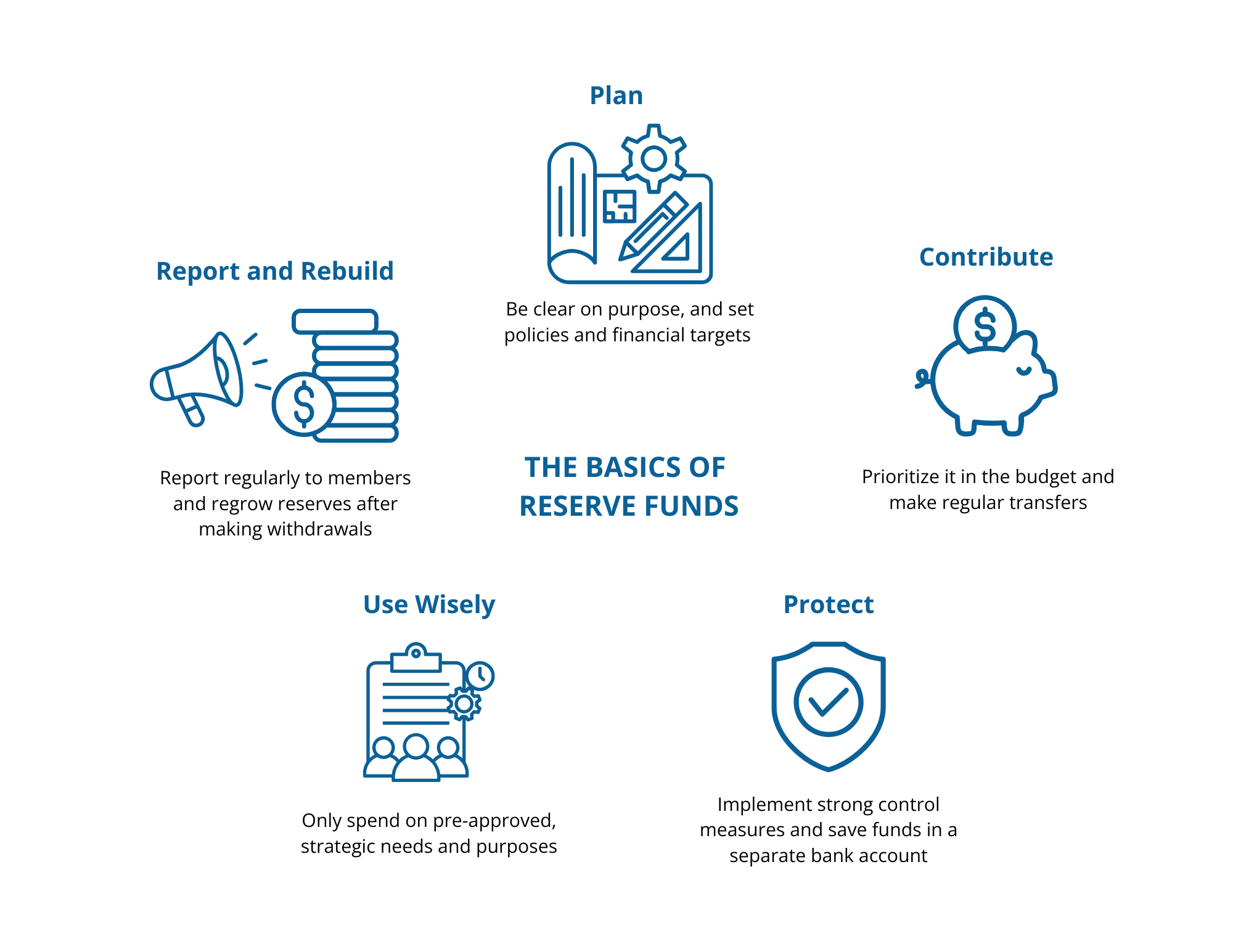
Reserve funds are built through intentional, regular contributions.
The two most common methods are to add a small, regular financial contribution to each member's invoice, and to allocate any net surplus at the end of the year to reserves. In both cases, water co- ops will seek their members' input and agreement at the Annual General Meeting (AGM).
Growing your reserve funds should be part of the budgeting and strategic planning process. The water co- ops always needs to plan ahead for replacing major infrastructure or equipment.
The best way to build a reserve fund is to make contributions on a monthly basis. Treat regular reserve fund contributions as a non- negotiable. If possible, try to adjust contributions to keep pace with changing capital costs, risks, or the regulatory environment.
WHERE TO KEEP YOUR WATER CO-OP'S RESERVE FUNDS
Reserve funds are kept separate from your rural water co- op's regular bank account.
To prudently manage these funds, the Board will want to choose a low- risk, interest- bearing account that meets the needs of the water co- op. This might be a Guaranteed Investment Certificate (GIC) or High Interest Savings Account (HISA), or another banking product that can be cashed in relatively quickly and easily.
As a control measure, your water co- op's reserve funds should be kept in an account that requires dual- signature authorization for withdrawals or account transfers.
Your water co- op will also want to have a written policy that strictly details what the reserve funds can be used for, when it's appropriate to use the funds, who can authorize account transfers, spending, or withdrawals from the reserve fund.
WHY RESERVE FUNDS NEED TO BE A PRIORITY
It's good financial governance to plan ahead as much as possible, in order to protect members from cash calls or sudden increases in rates. By doing proper financial forecasting and developing a funding plan for larger projects, the Board can provide more certainty and stability to members.
Regular contributions to a reserve fund demonstrate that the rural water co- op is being responsibly managed to meet the immediate and the long- term needs of the members.
A reserve fund offers regulators and members greater peace of mind that the water co- op will be able to respond and adapt appropriately over time and through changes in the market. As consumer and environmental protection standards and regulations change, rural water co- ops will be expected to make investments in assets and water system infrastructure, which can be quite costly.
RESERVE FUND MANAGEMENT CHECKLIST (BOARD SELF-ASSESSMENT)
POLICY AND PURPOSE
- Our Board of Directors shares a clear understanding of the purpose of reserve fund(s)
- Our water co- op has an account for operating cash and another account for reserve funds
- Our water co- op has a written Reserve Fund Policy that outlines:
- What the reserve fund is for
- When and how it can be use
- Who approves withdrawals (Board motion, well documented in the minutes)
- How deposits and withdrawals are tracked and reported
TARGET
- Our Board of Directors has set a target for how much money the water co- op would like to have in reserve funds, this year and over a certain time horizon (like three to five years)
- Our water co- op reviews the target at least once every year and adjusts as needed
- Our water co- op is on track to meet our target this year
CONTRIBUTIONS, REPLENISHMENT AND ACCOUNT MANAGEMENT
- Our water co- op holds reserves in a special, dedicated savings account and requires dual signing authority to make any withdrawals or account transfers
- Our water co- op has a funding plan in place (member contributions, allocating surplus, etc.)
- Transfers to the reserve fund are made consistently (monthly, quarterly, annually, etc.)
- When we use funds from our reserve account, we do so with a plan to replenish them
USE AND REPORTING
- Each reserve fund account has a clear purpose: capital projects, emergency repairs, etc.
- Our water co- op provides reporting on reserve funds at Board meetings and the AGM
- Our Board of Directors review (and approve) any withdrawals in advance
- Our members understand what the reserve fund is used for and how it benefits them
REVIEW AND IMPROVEMENT
- Our funding strategy supports our long- term capital projects and asset management plan
- Our Board of Directors annual reviews the Reserve Fund Policy and updates as needed
- Our Board of Directors has identified ways to gradually increase contributions as needed