The Underground Challenge: The Water Federation’s GIS Mapping Project
It’s not just maps. Geographic Information Systems (GIS) are influencing how Alberta’s water co-ops manage infrastructure by helping turn location-based data into smart, visual tools.
Owen Bennett, Business Systems Analyst and Project Manager with the Alberta Federation of Rural Water Co-operatives (the Water Federation), is leading a province-wide project to help improve mapping and support co-ops with better data.
|
“Most water co-ops in Alberta are volunteer-run, and one of the biggest challenges is the lack of accurate mapping for underground water lines,” explains Owen Bennett. “Some maps are decades old, damaged, or missing altogether. Without knowing where the pipes are, line location for third parties, repairs, leak detection and upgrades become more difficult.” |
The GIS project is helping to address this issue by collecting existing maps, recording known infrastructure, and building a province-wide map for water co-ops. The intended outcome is to preserve institutional memory and create a baseline for future planning.
|
"The GIS database is a digital system that standardizes, stores, and displays map data for the Water Federation and its members,” explains Liam Bennett, GIS mapping consultant. “By combining old paper maps, member knowledge, and field surveys, we are producing interactive maps that can support planning, maintenance, and upgrades to water infrastructure in the future." |
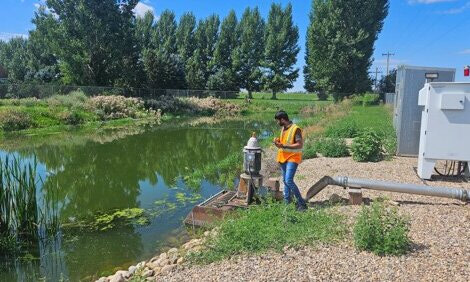
Launched in spring 2025, the project involves three team members traveling across Alberta to work directly with co-ops. So far, 38 of 100 site visits have been completed and 25 co-ops have been accurately mapped.
Site visits have revealed a common issue: many underground lines aren’t properly documented, and their exact locations are unknown. In these cases, the most valuable resource is often the historical knowledge of long-time co-op members and operators.
“We’re using high-precision Global Navigation Satellite System (GNSS) receivers to record the approximate position of infrastructure,” says Owen Bennett. “Even if a map is incomplete, we can combine it with local knowledge and GNSS data to build something more useful.”
After six months of work on this project, the Water Federation has some practical tips to help co-ops improve their mapping and maintenance for the future:
- Use tracer wire on new water lines. It makes it easier to find lines later with detection tools and can save money by reducing the need for hydrovac digging during repairs.
- Keep good records. Write things down and take pictures and videos of where lines are, and when work was done, to help avoid problems and save time. Make sure records are filed so that institutional knowledge is preserved.
- Talk to your operators. The people who know the system best are key to making good maps. Their experience fills in the gaps that paper maps cannot.
Water co-ops will be able to access updated maps and tools from this project through a secure login on the Water Federation website. They are encouraged to let the Federation know whenever new work is done to help keep the map current and useful for years to come.
Members of the public will be able to see co-op boundaries and will be encouraged to contact the relevant co-op before excavating within boundary lines.
Together, co-ops and the Water Federation are hoping to build better maps, stronger systems and a smarter future for rural water infrastructure.